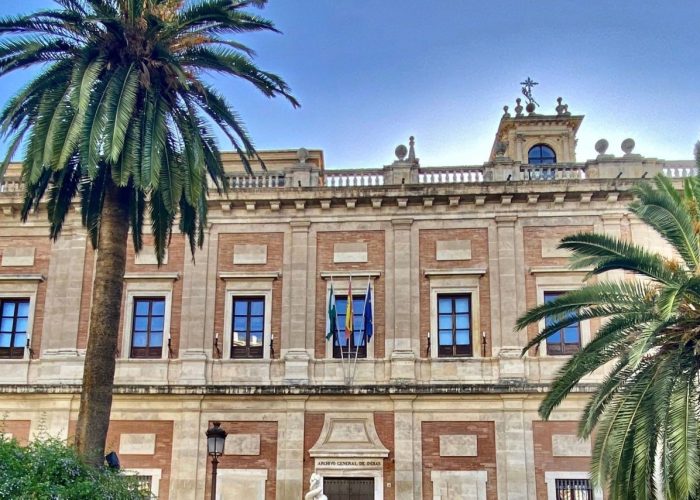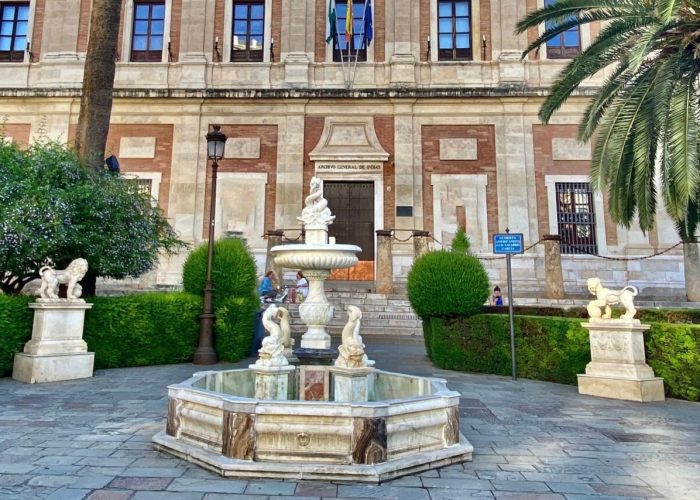

There’s a building in Seville that holds much of the history of the Americas within its walls: the Archive of the Indies.
For almost two centuries, this building served as a place where Seville’s merchants could make deals under cover, without having to negotiate outdoors. It later became the central repository for all the documents of the Spanish colonial administration.
It stands between the Cathedral and the Royal Alcázar, forming part of a trio of monuments you simply have to see when you visit Seville.
Many travelers leave it until last or sometimes skip it altogether, and we don’t know why. Let us convince you to step inside.
The origins of Seville’s Archive of the Indies
The story of this building begins with a complaint. For much of the 16th century, Seville’s merchants had no place of their own to do business, so they negotiated in and around the Cathedral. They had to shelter from the rain somehow!
Fed up with the situation, the Cathedral Chapter complained until Philip II commissioned Juan de Herrera, the architect of El Escorial, to design the Merchants’ Exchange in 1572.
Construction began in 1584, and the building opened on August 14, 1598, almost a quarter of a century later. Before becoming an archive, the building served several purposes: it housed the Maritime and Land Consulate, Murillo’s Academy of Painting and even the Seville Chamber of Commerce in one of its galleries.
The big turning point came in 1785, when Charles III decided to bring together all the documents relating to the Spanish colonies, which had previously been scattered between Simancas, Cádiz and Madrid. A curious fact? It took 24 mule-drawn carts to bring the documents from Simancas. That’s around 20 tons of paper!
And so Seville’s Archive of the Indies was born. Today, it’s considered one of the most important archives in the world.
What is the architecture like?
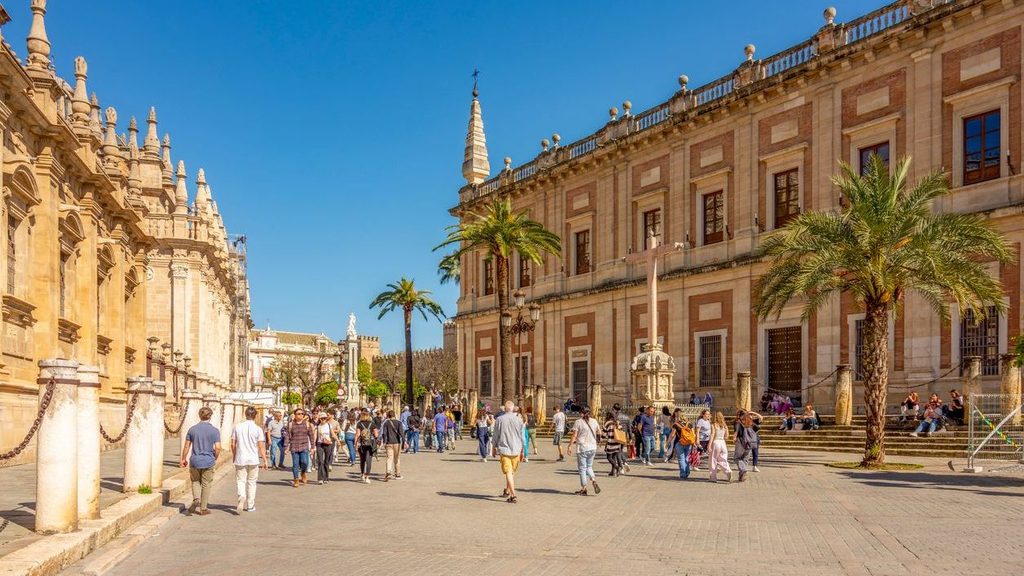
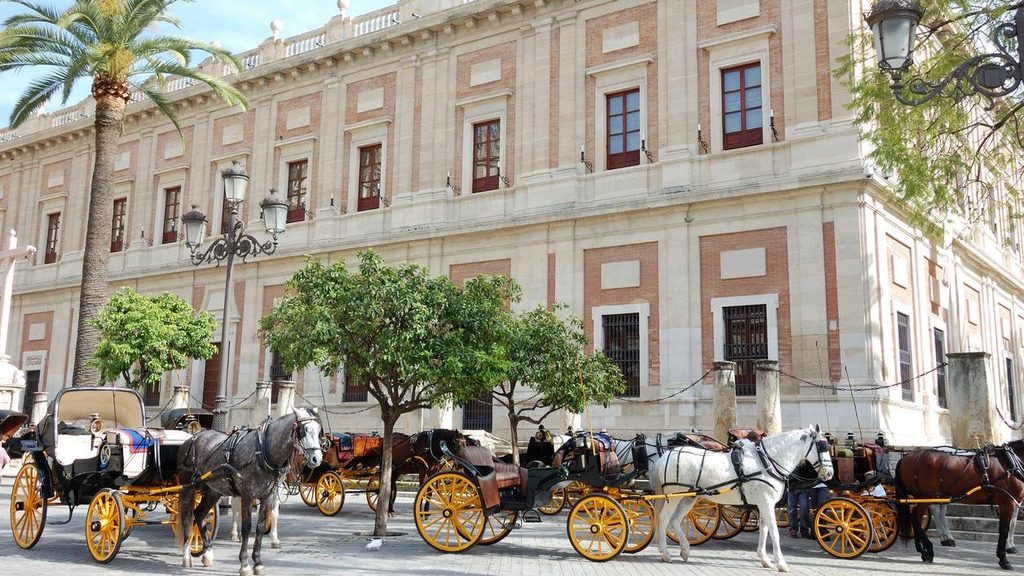
If you’ve visited other Seville buildings full of decorative tiles and intricate details, the Archive of the Indies will surprise you. It’s a two-story building with a square floor plan measuring 56 meters on each side and a stone facade built with almost mathematical precision: symmetrical openings, Doric and Ionic columns, and a cornice topped with a balustrade.
There’s nothing excessive here, and everything is in proportion. This is the so-called Herrerian style—the same as El Escorial’s—designed to convey strength and prestige. Let us know what you think when you step inside and discover the central courtyard and the magnificent arches, staircases, vaulted floors and lantern-topped dome.
The archive as you see it today no longer houses research and storage facilities, which have moved to an adjoining building known as “La Cilla.”
What to see inside
The visit isn’t long, but there are several details worth looking out for. Knowing where to focus makes all the difference, especially if you’re not taking a guided tour. Take note!
The entrance hall and Cintora staircase
As soon as you enter, you’ll see the first portraits and some beautiful vaulted ceilings. Climb the majestic Cintora staircase to reach the upper floor, where you’ll find a 16th-century chest and paintings of monarchs and explorers such as Columbus, Isabella II, Alfonso XII, Magellan and Elcano.
The upper gallery
Once a study room for researchers, this is now a spectacular exhibition space with shelves separated by pilasters and topped by truly beautiful vaulted ceilings.
Look up at the ceilings and explore the exhibits, including antique maps, models of the building itself and audiovisual displays about its history. And of course, take a look at the royal cannon recovered from the Spanish galleon Nuestra Señora de Atocha, which sank in 1622. It’s spectacular!
The lower gallery
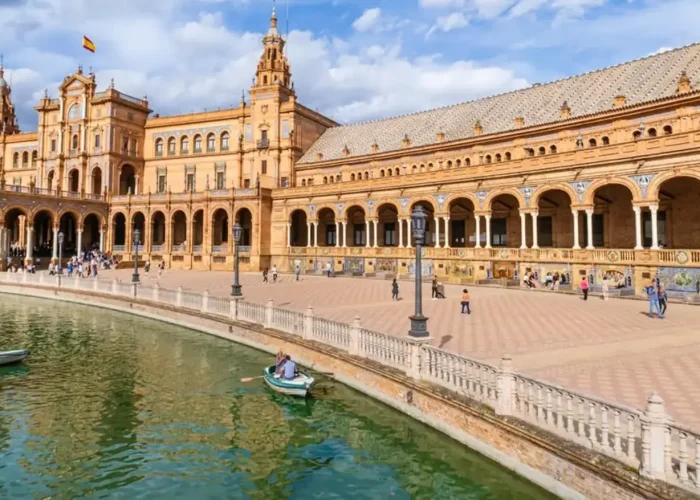
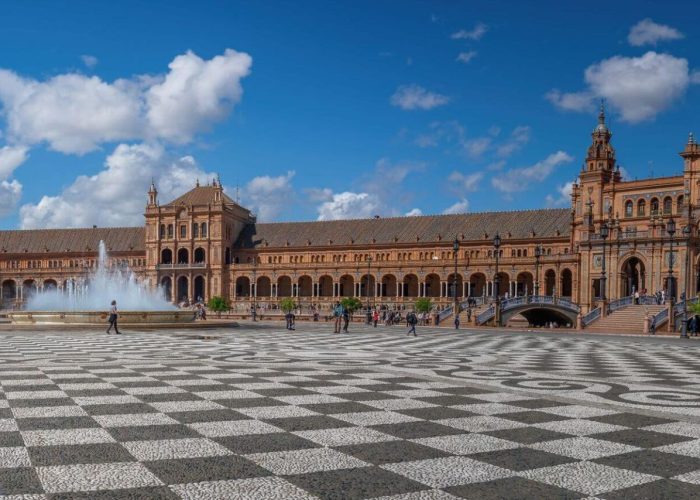
The ground floor retains elegant metal shelves donated for the 1929 Ibero-American Exposition, the same event that gave Seville the Plaza de España and much of its present-day appearance.
The book annotated by Columbus
Look out for this detail! Abraham Zacuto’s Perpetual Almanac is on display here. Christopher Columbus himself took this book on his voyages and wrote notes in it in his own hand to help him navigate at sea.
Standing just centimeters away from it is sure to make an impression!
Interesting facts about what you’ll see at the Archive of the Indies
Much of what you see on the gallery shelves is not original documents. The wood of the shelves is authentic—mahogany and cedar brought over from Cuba specifically for this purpose in the 18th century—but most of the boxes stacked on them are decorative replicas made by Francisco Hohenleiter, an illustrator from Cádiz.
The actual bundles of documents—the 43,000 that make up the bulk of the archive, with more than 80 million pages—have been stored for decades in temperature- and humidity-controlled basements and can only be consulted by accredited researchers. What’s on display is essentially the museum version of the Archive of the Indies.
Wondering which documentary treasures are kept here and which aren’t?
The archive holds, for example, a letter signed by George Washington himself and sent after Spain’s assistance during the American War of Independence.
But despite the rumors, Juan de la Cosa’s 1500 map—considered the first known cartographic representation of the Americas—is not at Seville’s Archive of the Indies, but at the Naval Museum in Madrid.
What you will find in the archive are many other cartographic treasures, just as valuable for understanding how Europe discovered, map by map, what the Americas really looked like.
How to visit: admission and opening hours
Visiting the Archive of the Indies is completely free. You don’t need to book in advance, and you can explore at your own pace. Allow around 30 to 45 minutes. If you’d prefer someone to tell you the story as you go, paid guided tours are also available. You can find more information here.
It’s open Tuesday to Saturday from 9:30 AM to 5:00 PM, and on Sundays and public holidays from 10:00 AM to 2:00 PM. You can get there on foot, by metro—Puerta de Jerez—or on the T1 tram.
Don’t miss the UNESCO World Heritage ensemble
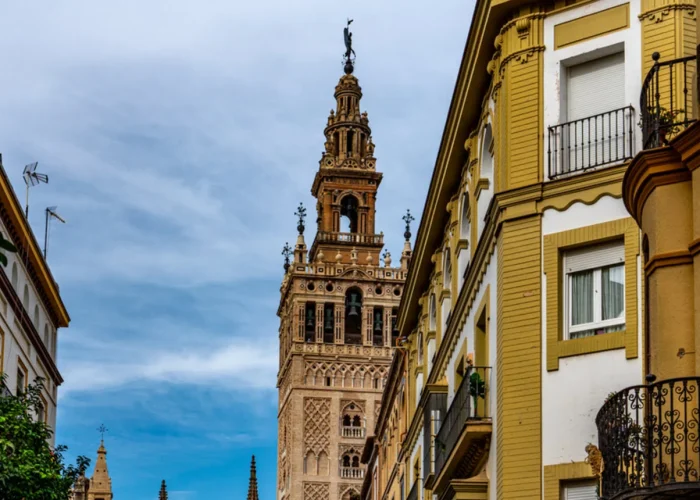
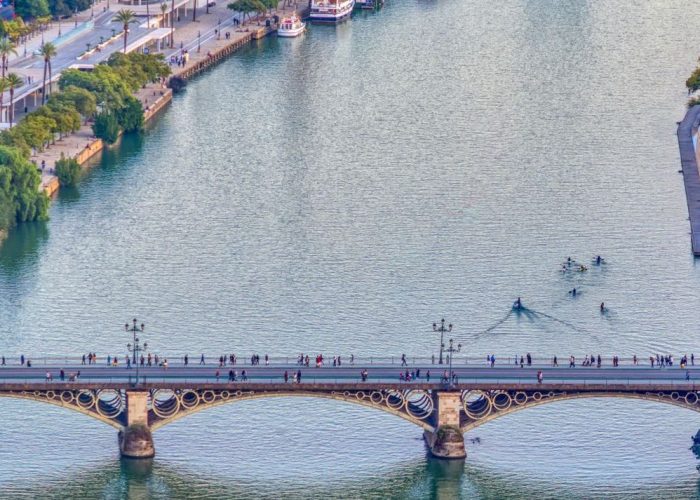
Still thinking of skipping it? In 1987, UNESCO designated the Cathedral, the Royal Alcázar and the Archive of the Indies together as a World Heritage Site. You can’t leave it off your itinerary. And while you’re here, don’t miss Triana or La Giralda either.
If you’re short on time, just find a place to stay with WAOU Rentals and extend your vacation a little longer.